Passing a prop firm challenge like FTMO can be difficult, especially when it comes to respecting strict risk management rules and daily drawdown limits.
In this guide, we will show you a simple and effective method to help you pass the challenge using an automated trading robot.
🤖 What You Will Learn in This Video
In the video below, we demonstrate how to install and run the ZNJEA trading robot on your account step by step.
This robot is specifically designed for:
Funded accounts (FTMO, prop firms)
Small accounts
Traders who want automated execution with controlled risk
We apply a risk of one percent per trade to maintain stability and protect the account from large drawdowns.
📊 Markets Used in This Strategy
In this setup, we trade multiple markets to diversify risk:
Gold (XAUUSD)
EUR/USD
Bitcoin (BTC)
Each trade follows the same strict risk management rules.
⚙️ Fully Automated Trading
The robot works 100% automatically, adapting to the market using:
News data
Technical analysis
Once set up, it can trade continuously without manual intervention.
💻 Run Your Robot 24/7 with VPS
To keep the robot running non-stop, we use a VPS (Virtual Private Server).
This allows:
24/7 trading
No need to keep your PC on
Stable and uninterrupted execution
👉 If you don’t know how to set up a VPS or install MT5, check our previous video where everything is explained step by step.
🌍 Multi-Language Support
You can watch this video in your preferred language by enabling YouTube Auto-Translate subtitles:
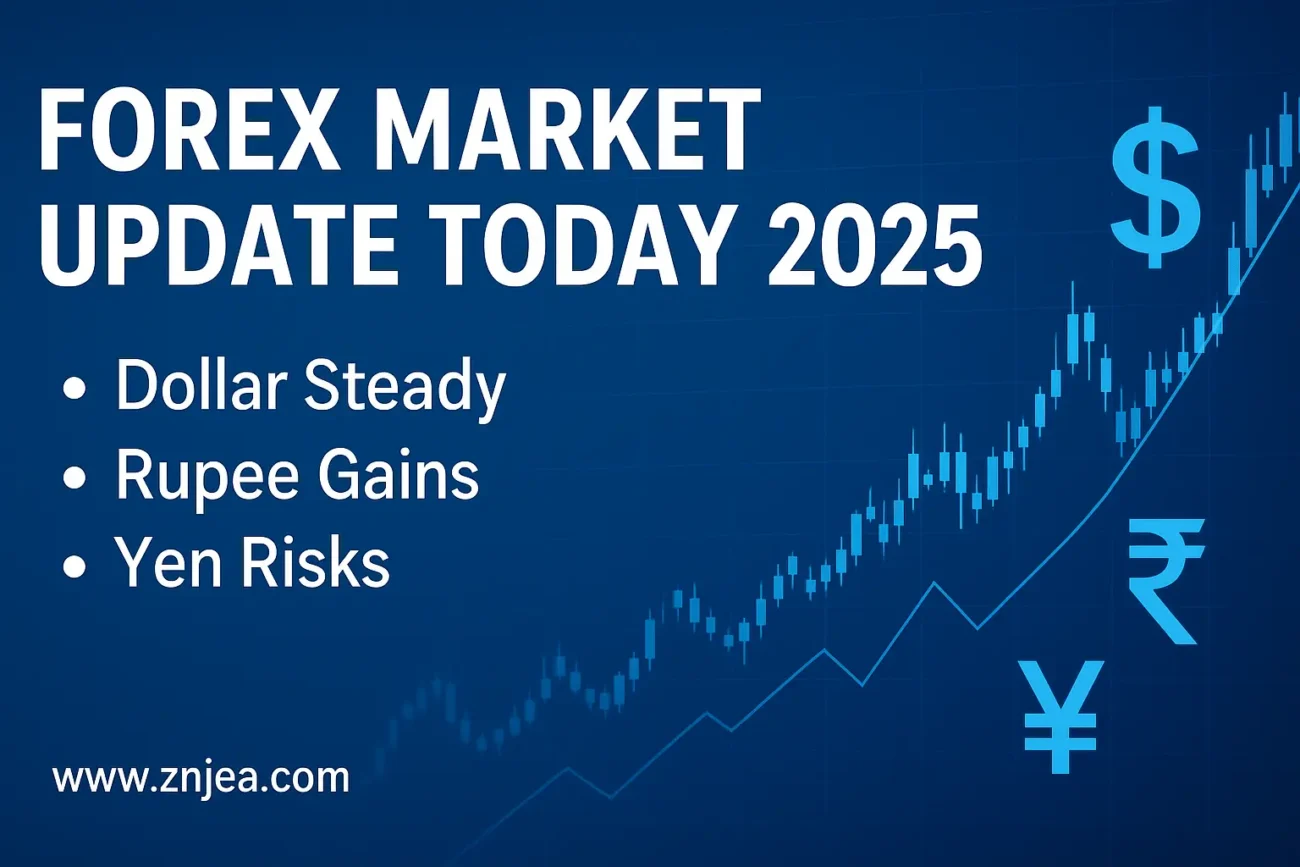
The forex market update today 2025 shows the dollar holding steady while the Indian rupee gains and the Japanese yen stays under pressure near potential intervention levels. Traders are watching central bank signals, commodity prices, and risk sentiment, as these factors continue to drive volatility across major and emerging-market currency pairs.
Indian Rupee Shows Early Strength
The Indian Rupee (INR) appreciated by around 11 paise, trading near 89.05 against the US Dollar in early sessions. This short-term improvement is supported by falling global crude oil prices, reduced import pressure, and slowing dollar momentum, which together ease pressure on India’s trade balance.
However, the rupee still faces downside risks from weak domestic equities and foreign capital outflows. Emerging-market currencies remain vulnerable, so if the US Dollar regains strength, the rupee could quickly give back today’s gains despite the current positive move.
US Dollar Holds Steady as Traders Await Fed Signals
The US Dollar is in a consolidation phase as markets wait for clearer direction from the Federal Reserve and upcoming US macroeconomic data. Mixed economic releases have created a pause in the dollar’s medium-term trend, leading to range-bound major currency pairs and reduced short-term volatility.
This environment typically favors short-term scalping strategies, algorithmic trading, and forex robots that adapt to low-volatility conditions. Many intraday traders prefer to focus on clearly defined support and resistance levels when the dollar trades sideways rather than trending strongly.
Japanese Yen Near Intervention Zones
The Japanese Yen continues to trade close to levels where the Japanese government and the Bank of Japan may consider direct intervention. Fiscal uncertainty and wide yield differentials with other major economies are putting additional pressure on the yen against the dollar and other major currencies.
If intervention occurs, traders should expect sudden and aggressive volatility, especially in USD/JPY, EUR/JPY, and GBP/JPY. Managing position size, using conservative leverage, and placing protective stop losses are critical when the risk of official action increases in the forex market.
Commodity-Linked Currencies Gain as Gold Rebounds
As the dollar’s upward momentum slows, key commodities such as gold have started to recover from recent pullbacks. This rebound is giving strength to commodity-linked currencies like AUD, NZD, and CAD, which often benefit when investors regain confidence in risk assets.
These currencies tend to rise when commodities strengthen or when the dollar loses some momentum. Traders following the forex market update today 2025 are closely watching correlations between gold, oil, and these currencies to refine trend and breakout strategies.
Today’s Key Market Drivers
US inflation and employment data Any major surprises in inflation or jobs figures can quickly change expectations for Federal Reserve policy and impact all USD pairs. Traders are closely monitoring releases that could shift rate projections and trigger breakouts from current ranges.
Possible Japanese intervention Official action or strong verbal warnings from Japanese authorities could trigger fast moves in JPY-crosses. Short-term traders and EA users should be ready for sharp spikes and potential slippage during such events.
Commodity and oil movements Lower oil prices tend to support large importers such as India, while higher oil prices benefit exporters like Canada and some Middle Eastern economies. These moves feed directly into currencies like INR and CAD through trade and inflation channels.
Global risk sentiment In risk-on environments, AUD, NZD, and CAD often gain as investors seek higher-yielding assets. In risk-off conditions, safe-haven currencies such as USD and JPY usually strengthen as traders hedge against uncertainty in global markets.
ZNJ EA Insights: How Robots Should Trade Today
For traders using ZNJ EA robots, today’s forex market update suggests a blend of consolidation and event-driven volatility. Major pairs may remain sideways for much of the session, so optimizing settings for short scalps, tight ranges, and high-probability intraday setups can be effective.
At the same time, JPY pairs and some commodity currencies can experience sharp spikes during economic data releases or intervention headlines. ZNJ EA is designed to operate efficiently in both consolidation and breakout phases, helping traders automate entries, exits, and risk management on days when the market lacks a clear long-term direction.
Practical Tips for Today’s Trading Session
Focus on clearly defined support and resistance levels on major USD pairs while volatility remains contained.
Monitor JPY crosses closely near key intervention levels and reduce leverage before major news events.
Track gold and oil prices when trading AUD, NZD, and CAD, as changes in commodities can quickly shift sentiment.
Use strict risk management rules, including stop losses and maximum daily drawdown limits, especially when trading with EAs or during high-impact news.
Conclusion: Today’s Forex Market Outlook
Overall, the forex market update today 2025 presents a steady dollar, a modestly stronger rupee, and a fragile yen that remains at risk of intervention. Traders who combine technical levels, macro data, and automated tools like ZNJ EA can better navigate this mix of cautious sentiment and selective volatility in the current forex environment.
The prop firm industry has changed dramatically over the last three years. What started as a simple challenge-based model has now expanded into new funding systems that allow traders to access capital instantly — without multi-step challenges, without long waiting periods, and without unnecessary stress. Among the companies leading this new trend is WeMasterTrade, a prop firm that offers a true instant funding model combined with flexible trading rules, MT5 compatibility, and a structure that supports both manual trading and automated trading using robots (expert advisors).
In this article, we will explore everything you need to know about instant funding, why it is becoming the preferred choice for 2025, and how WeMasterTrade stands out with features like daily drawdown upgrades, no challenge requirements, and full EA compatibility. We will also explain why many traders are using our ZNJ EA trading robot to pass tests or manage accounts instantly — and how you can benefit from exclusive discounts through the official links.
What Is an Instant Funded Account?
Instant funding is a model where traders get access to a funded trading account immediately after purchase, without the need to pass any evaluation or challenge. This means:
No Phase 1 challenge
No Phase 2 verification
No minimum trading days
No waiting to start earning payouts
Everything begins instantly — traders purchase the account, receive MT5 login details, and start trading.
In the past, traders had to spend weeks trying to pass challenges just to qualify for payouts. Many lost time, lost money, and got stuck in the endless challenge cycle. Instant funding solves this problem entirely.
This is why so many traders in 2024–2025 shifted from traditional evaluations to instant funded accounts.
Why Instant Funding Saves Time — and Why Time Matters
The biggest advantage of instant funding is time efficiency. If you take a challenge with traditional prop firms, you must:
Pass a profit target
Respect strict rules
Spend multiple days or weeks
Repeat the entire process if you fail
Instant funding eliminates all of that. You focus directly on trading and earning.
For traders who value speed, convenience, and efficiency — instant funding is the smartest choice.
Why WeMasterTrade Is One of the Strongest Instant Funding Options in 2025
There are many prop firms on the market, but not all of them offer true instant funding. Many still require a mini-test or verification phase.
WeMasterTrade, however, offers a real instant funding model with:
Immediate activation
Zero challenges required
EA / robot trading allowed
Scalping, news trading, swing trading permitted
Risk-free structure (the firm absorbs losses)
High leverage
Fast payouts
Profit shares up to 90%
Additionally, the company has an advanced system that replicates your trading into real liquidity accounts, meaning your virtual account performance can generate real payouts.
Account Types & Prices (Instant Model)
WeMasterTrade offers several instant funding account sizes:
$10,000 – $140
$25,000 – $350
$50,000 – $700
$100,000 – $1,350
$200,000 – $2,640
These are one-time setup fees — not subscriptions.
Each account comes ready to trade immediately after purchase.
Select your preferred account size from $10,000 to $200,000.
3. Upgrade Your Drawdown (Optional)
Enable 5% daily DD and 10% max DD for safer trading.
4. Pay the Setup Fee
Instant activation after payment.
5. Receive MT5 Login Details
Your trading account arrives by email or dashboard.
6. Connect Your EA or Trade Manually
You can:
Trade manually
Use ZNJ EA
Copy trade
Use news strategies
7. Request Payout
Profit splits can reach 90% depending on the account.
That’s all — no challenge, no verification.
Why Instant Funding Is a Better Choice for Many Traders
Here are the top reasons traders in 2025 prefer instant funding:
✔ No time wasted
Instant activation means you start earning from day one.
✔ No risk of failing a challenge
Most challenge accounts fail due to stress or tight rules — instant funding removes this problem.
✔ Fits EA / robot trading
Many traders use EAs full-time, and instant funding supports this model.
✔ Better psychology
Without pressure, traders perform better and more consistently.
✔ Structured for long-term payouts
The upgraded drawdown system makes the account more stable.
If your goal is to trade calmly, professionally, and without headache — instant funding is a powerful solution.
WeMasterTrade vs. Traditional Challenge Firms
Feature
Traditional Challenge
WeMasterTrade Instant
Challenge required
Yes
No
Time to start
Weeks
Immediate
Drawdown rules
Strict
Flexible (5%/10% upgrade)
EA Allowed
Sometimes
Yes
Risk of repeat
High
Zero
Stress
High
Low
Instant funding clearly wins in simplicity and trader efficiency.
Final Thoughts: Instant Funding Is the Future — and WeMasterTrade Is Leading the Way
The world of prop trading is evolving, and traders need models that are:
Faster
Simpler
More flexible
EA-friendly
Designed for real consistency
WeMasterTrade has created one of the strongest instant funding systems in the market. With features like MT5 support, EA compatibility, drawdown upgrades, fast payouts, and high profit splits — it’s a top choice for traders in 2025.
If you want to start trading instantly and avoid wasting weeks on challenges, this is the right moment to begin.
Whether you’re an experienced trader or a beginner looking for a fast way to access capital, instant funding is the most efficient route today.
⚠️ Trading Disclaimer (Required)
Trading financial markets, including Forex, indices, metals, and cryptocurrencies, involves significant risk. Past performance does not guarantee future results. Prop firm accounts are simulated or virtual accounts, and profits depend on respecting firm rules. Using trading robots (EAs) does not eliminate risk. Only trade with money you can afford to lose, and always manage risk responsibly. This article is for educational purposes only and does not constitute financial advice.
Over the past few years, ICT (Inner Circle Trader) concepts have become one of the most discussed and practiced trading strategies in the Forex community. Developed by Michael J. Huddleston, ICT focuses on market structure, liquidity, and institutional order flow rather than relying solely on indicators. Many professional traders and algorithmic developers, including us at ZNJEA, use ICT as the foundation for building profitable and sustainable trading systems.
In this article, we will dive deep into ICT strategies, explain why they are so powerful, and show you how they can transform your trading journey. By the end, you will also discover how our ZNJ EA PropFirm Robot incorporates ICT methods to help traders pass prop firm challenges and succeed in live accounts.
What is ICT Trading?
ICT stands for Inner Circle Trader, a trading approach that focuses on understanding how smart money (institutions, banks, hedge funds) moves the market. Instead of trading based on random signals or lagging indicators, ICT concepts teach traders to follow the footprints of liquidity providers.
Some of the core ideas include:
Market Structure: Identifying trends, break of structure (BOS), and shifts in market direction.
Liquidity Pools: Understanding where stop losses and pending orders are placed by retail traders.
Fair Value Gaps (FVGs): Imbalances in the market where price is likely to return before continuing its trend.
Order Blocks: Key institutional footprints where big players place their orders.
Optimal Trade Entry (OTE): Using Fibonacci retracement to find high-probability entry zones.
ICT is not about predicting the market blindly. It’s about understanding the logic of price delivery.
Why ICT Concepts Are So Effective
There are countless strategies in the Forex world, so what makes ICT stand out?
Institutional Perspective: ICT allows you to trade with the same logic big banks use, instead of fighting against them.
Liquidity Awareness: Most retail traders lose money because they place stops in predictable areas. ICT flips this disadvantage into an advantage.
High Risk-to-Reward Opportunities: By identifying precise entry points like FVGs or order blocks, you can target small stop losses and larger profits.
Works Across All Timeframes: Whether you’re scalping, day trading, or swing trading, ICT concepts can be applied consistently.
Backtestable & Algorithm-Friendly: ICT logic is clear and rules-based, making it perfect for building automated trading robots like the ones we develop at ZNJEA.
Key ICT Concepts Explained
1. Market Structure
Every trader must understand higher highs, higher lows, lower highs, and lower lows. ICT focuses heavily on Break of Structure (BOS) and Market Structure Shifts (MSS).
A BOS confirms continuation.
An MSS signals potential reversal.
By following structure, traders avoid guessing and instead follow the natural flow of price.
2. Liquidity Pools
Liquidity is where price is attracted. ICT teaches us that stop losses, pending orders, and breakout traders create liquidity pools. For example:
Above recent highs = buy-side liquidity.
Below recent lows = sell-side liquidity.
Institutions push the market into these pools to trigger stops and collect liquidity before reversing.
3. Fair Value Gaps (FVGs)
An FVG is a three-candle pattern where the middle candle leaves an imbalance in price. Price often retraces into this gap to “rebalance” before continuing. Traders use FVGs to identify entry zones with high precision.
4. Order Blocks
An order block is the last bullish or bearish candle before a major market move. They represent where institutions place orders.
Bullish Order Block = Last down candle before price moves up strongly.
Bearish Order Block = Last up candle before price moves down strongly.
Order blocks often act as support and resistance zones with high reliability.
5. Optimal Trade Entry (OTE)
The OTE entry is based on Fibonacci retracement (61.8%–79%). ICT traders wait for price to return to this zone for the best entry with low risk and high reward.
ICT in Action: Example Trading Setup
Imagine EURUSD is trending upward. Price breaks structure to the upside, creating a bullish scenario. After the rally:
We identify a bullish order block before the move.
A fair value gap forms in the same zone.
Liquidity sits below recent lows.
Price retraces into the order block and FVG, aligning with the OTE zone.
This confluence creates a high-probability entry. A trader can go long with a tight stop loss under the liquidity pool and target the next buy-side liquidity.
Why Traders Love ICT
Clarity: Instead of relying on multiple lagging indicators, ICT simplifies decision-making.
Confidence: When you understand why price moves, you stop second-guessing yourself.
Consistency: ICT provides repeatable setups that can be used daily.
No wonder thousands of traders worldwide are switching to ICT.
ICT and Algorithmic Trading (EAs)
One of the most exciting applications of ICT is in Expert Advisors (EA robots). Since ICT concepts follow structured rules, they can be coded into algorithms.
At ZNJEA, we design robots that incorporate ICT strategies to:
Identify liquidity zones automatically.
Detect order blocks and FVGs.
Manage trades with smart risk-to-reward ratios.
Execute entries faster than humans can.
This makes ICT-based EAs perfect for both manual traders who want confirmation and automated traders who prefer hands-off trading.
Pass prop firm challenges with disciplined risk management.
Trade automatically using order blocks, liquidity grabs, and fair value gaps.
Work on both MT4 and MT5.
Adapt to different account sizes with pre-set parameters.
By combining ICT logic with automated execution, this robot helps traders stay consistent and avoid emotional mistakes.
Conclusion
ICT trading is not just another strategy – it’s a complete framework for understanding how the markets truly work. By focusing on liquidity, market structure, and institutional order flow, traders can gain a real edge over the majority of retail participants.
If you are serious about becoming a professional trader, learning ICT is a must. And if you want to take it one step further, our ZNJ EA PropFirm Robot and other EAs are already built on these principles, giving you the power of ICT in an automated form.
We also provide a special ICT & SMC indicator for traders who prefer to trade manually but still want clear visual guidance on liquidity zones, fair value gaps, and order blocks. This indicator combines the best of ICT (Inner Circle Trader) and SMC (Smart Money Concepts), giving you precise confirmations directly on your charts.
👉 Whether you choose to trade with our EA robots or with our ICT & SMC indicator, ZNJEA equips you with professional tools designed to help you succeed.
In a recent interview on NBC’s Meet the Press, U.S. Treasury Secretary Scott Bessent denied that Trump tariffs tax American consumers directly. His claim contradicts former President Donald Trump’s widely-debated position on whether tariffs act as taxes. This statement comes amid concerns from major companies, including Nike and John Deere, which warned that tariffs could cost billions of dollars annually.
Bessent’s Defense: Economy Claims
The Reality: Economic Data
The Treasury Secretary also commented on ongoing legal challenges. The administration is appealing a federal court ruling that Trump exceeded his authority with broad tariffs, including extreme cases like a 50% tariff on Lesotho. The Supreme Court will hear the case in early November. If the court overturns the ruling, the government will face substantial refund obligations.
Former Treasury Secretary Janet Yellen, however, has consistently warned that tariffs function as hidden taxes, raising costs for households and businesses and potentially destabilizing the global economy.
Market Implications for Traders:
Stocks: Domestic manufacturers could benefit, while import-heavy companies may face higher costs.
Forex: The USD could strengthen if tariffs are perceived as non-disruptive.
Commodities: Gold and metals may see volatility amid economic uncertainty.
Bonds: Treasury yields may fluctuate depending on growth expectations.
For traders and investors, keeping an eye on economic data, corporate earnings, and court decisions will be key to navigating the market amid tariff uncertainty.