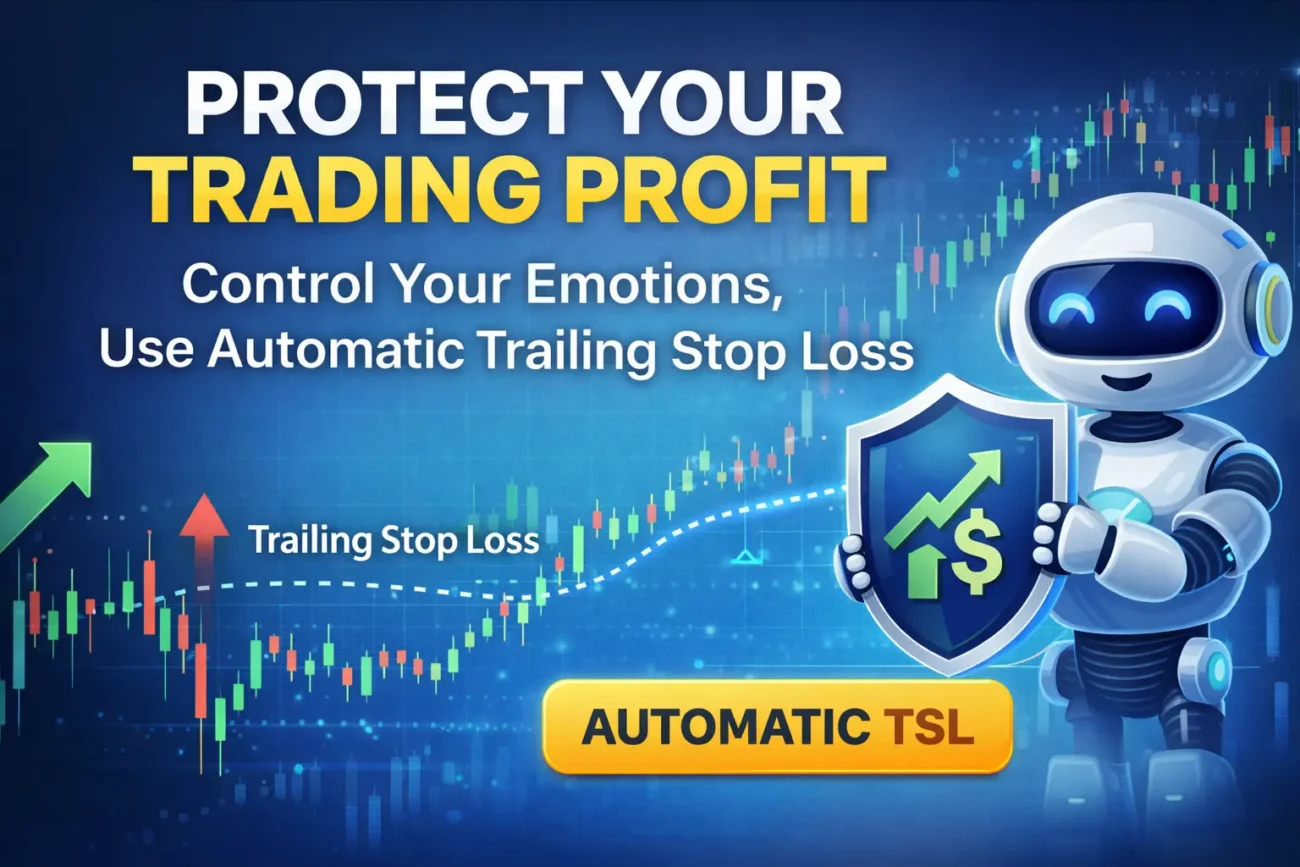
Protect trading profit using automatic trailing stop loss with ZNJEA trading robot

How to Protect Your Trading Profit (And Why Most Traders Fail to Do It)

Many traders can enter good trades.
Many traders can even reach take profit.

But very few traders know how to keep the profit.

That’s the real difference between a trader who survives…
and a trader who slowly gives everything back to the market.


The Common Scenario Every Trader Knows

It usually looks like this:

  • You enter a trade with confidence
  • The position goes into profit
  • Price touches your TP level
  • You hesitate…
  • You move your Stop Loss emotionally
  • The market reverses
  • The trade closes at Break Even or loss

At the end, you were right on direction…
but you didn’t get paid.

👉 The problem is not the entry.
👉 The problem is profit management.


The Harsh Reality of Trading

Winning money is a skill.
Keeping money is a mindset.

The market does not reward traders who are right most of the time.
It rewards traders who know:

  • When to protect
  • When to hold
  • When to let go

A simple truth every professional trader understands:

Money on the account is more important than money on the chart.


Losing Trader vs Profitable Trader

❌ Losing Trader

  • Takes profit too early out of fear
  • Moves Stop Loss emotionally
  • Hopes instead of managing
  • Turns profit into stress

✅ Profitable Trader

  • Has a profit protection plan before entry
  • Accepts missing the end of the move
  • Never regrets secured profit
  • Trades with logic, not emotions

3 Golden Rules to Protect Your Profit

1️⃣ Profit Is an Asset, Not a Dream

When the market pays you, your role is not to ask for more.
Your role is to protect what you already earned.

If the market reverses now, will you be satisfied with this profit?
If the answer is no → profit is not protected yet.


2️⃣ Move Stop Loss With Logic, Not Fear

A Stop Loss should follow market structure, not emotions.

Manual SL management often leads to:

  • Over-tight SL
  • Early exits
  • Emotional decisions

This is where most traders fail.


3️⃣ Taking Profit Is Never a Mistake

The only real mistake is:

Letting a winning trade become a losing one.

Professional traders don’t try to catch the entire move.
They focus on consistent extraction of profit.


Why Manual Profit Protection Fails

Even with a good strategy, manual management is dangerous because:

  • Emotions react faster than logic
  • Fear increases when profit grows
  • Discipline breaks under pressure

That’s why many profitable traders automate profit protection.


The Smart Solution: Automatic Trailing Stop Loss (TSL)

An automatic Trailing Stop Loss removes emotions completely.

Instead of asking:

“Should I move my SL now?”

The system does it for you, based on predefined rules.

Benefits of Automatic TSL:

  • Protects profit step by step
  • Locks gains logically
  • Adapts to market movement
  • Eliminates emotional decisions
  • Keeps consistency over time

How ZNJEA Robot Protects Your Profit Automatically

The ZNJEA trading robot is designed with one core objective:

Protect profits first. Grow accounts second.

Key Features:

  • Smart automatic Trailing Stop Loss
  • Logical SL movement based on price behavior
  • No emotional interference
  • Designed for long-term account survival
  • Suitable for prop firms and personal accounts

Instead of hoping the market continues,
ZNJEA secures profit as the market moves.


Final Thought

Protecting profit won’t make you rich overnight.

But it is the only reason your trading account survives long enough to grow.

Trading is not about maximizing one trade.
It’s about optimizing the entire journey.

If you master profit protection,
the market will finally start paying you consistently.

Forex market update today 2025 with dollar steady, rupee gains and yen under pressure.

Flash Crashes & Systemic Risk in Forex 2025: How AI Trading Bots Shape Market Stability

Introduction

The forex flash crash 2025 risk is rising as markets become more automated and AI-driven.


1. The Evolution of Forex Into an Automated Market

Automation dominates the forex ecosystem.
Therefore, more than 80% of global currency trades are now executed by algorithms and trading robots. This shift has introduced several advantages, including tighter spreads and faster execution.
However, it has also created a market environment where errors can spread quickly.

Forex automation is driven by:

  • High-frequency trading (HFT) systems
  • AI prediction models
  • EAs on MT4/MT5
  • Automated liquidity engines
  • Smart order routing

Because so many systems operate simultaneously, even small disruptions can escalate rapidly.


2. What Is a Flash Crash?

A flash crash is a sudden and sharp drop in price that occurs within seconds. It is usually followed by a fast recovery.
In other words, the market collapses temporarily before returning to normal levels.

Typical flash crash features include:

  • Rapid price collapse
  • Liquidity disappearance
  • Massive spread widening
  • Execution delays
  • Stop-loss cascades

These events are dangerous because traders have almost no time to react manually.


3. Why Flash Crashes Happen in Forex

3.1 Liquidity Withdrawal

During periods of uncertainty, liquidity providers may pull their orders instantly.
As a result, the market becomes unstable and more vulnerable to sharp movements.


3.2 Algorithmic Overreaction

Algorithms are built to react quickly to price changes.
Consequently, when one algorithm triggers a sell order, others may follow, creating a chain reaction.


3.3 Stop-Loss Cascades

Flash crashes often trigger thousands of stop-losses.
Therefore, the downward movement becomes amplified, especially during high volatility.


3.4 High-Frequency Trading Withdrawal

HFT systems dominate short-term liquidity.
When they detect unusual volatility, they immediately withdraw, causing spreads to spike dramatically.


3.5 Data Glitches

Sometimes, markets react to incorrect information or delayed feeds.
For example, a wrong economic number or duplicated price tick can trigger algorithmic panic.


3.6 AI Model Synchronization

AI models increasingly learn similar patterns.
Consequently, thousands of bots may buy or sell at the same time, causing coordinated volatility.


4. The Bigger Issue: Systemic Risk in Forex

Flash crashes are symptoms of deeper systemic issues.

4.1 Highly Connected Markets

Forex pairs influence each other.
Therefore, when a major pair like USD/JPY crashes, gold, crypto, and stock indices often react instantly.


4.2 Central Bank Concerns

Regulators are worried because:

  • AI evolves faster than regulation
  • Machine behavior is unpredictable
  • Market manipulation becomes harder to detect

Furthermore, even central banks now use AI tools to monitor global liquidity.


4.3 Retail Trader Exposure

Retail traders rely heavily on automation:

  • EAs
  • Copy trading
  • VPS setups

However, without proper filters, these tools can amplify risks during a flash crash.


4.4 Prop Firm Sensitivity

Prop firm accounts have strict daily limits.
Therefore, even a small flash crash can instantly violate rules.


5. How EAs Influence Flash Crashes

5.1 How EAs Make Crashes Worse

Certain robots increase market instability because:

  • They are over-optimized
  • They use martingale or grid strategies
  • They have no stop-loss logic
  • They do not include volatility filters

Consequently, these robots are often the first to blow accounts during chaotic events.


5.2 How EAs Help Prevent Losses

Modern EAs include:

  • Spread filters
  • ATR volatility control
  • News filters
  • Equity protection
  • Auto-shutdown during spikes

Moreover, advanced AI EAs can detect abnormal market behavior before humans notice.


6. Why Flash Crashes Are Increasing in 2025

6.1 Growing AI Adoption

As more traders use AI bots, the probability of synchronized behavior increases.

6.2 Retail Automation Growth

More retail EAs means more identical strategies.
Therefore, market reactions become amplified.

6.3 Volatile Global Conditions

Political instability and interest rate uncertainty are pushing markets into higher volatility.

6.4 Rise of Digital Currencies

New CBDC systems introduce additional liquidity risks.
As a result, the forex market becomes more complex.


7. How Traders Can Protect Themselves in 2025

7.1 Use Well-Designed EAs

Avoid robots that:

  • Use martingale
  • Trade without stop-loss
  • Do not manage volatility

Instead, look for EAs with:

  • Drawdown protection
  • Volatility filters
  • Smart SL/TP placement

7.2 Avoid Trading Major News

High-impact events such as NFP and FOMC often trigger flash crashes.
Consequently, staying out of the market during these moments reduces risk.


7.3 Use ECN Brokers

Brokers with deep liquidity reduce slippage.
Therefore, they perform better during sudden market drops.


7.4 Use a Low-Latency VPS

Execution speed matters during volatility.
In addition, VPS hosting prevents delays that could worsen losses.


7.5 Combine EAs With Manual Knowledge

Automation helps, but manual analysis improves risk management.
Moreover, traders who understand price action react better to unexpected events.


8. Are Forex Flash Crashes Becoming More Common in 2025?

Yes — they are.
However, better AI tools are also emerging to protect traders.

The future will rely on:

  • Human experience
  • Smart automation
  • Strong risk management

Therefore, the best traders in 2025 will combine technology with disciplined strategy.


Conclusion

In 2025, the forex flash crash 2025 risk is real, but traders can reduce it with smart automation and risk management.

SMC vs ICT: Understanding the Difference in Smart Money Trading

If you’re diving into the world of forex or indices trading, you’ve probably come across two popular terms: ICT and SMC. Both are rooted in the idea of “smart money” — understanding how institutional traders move the market — but they differ in style, approach, and application.

In this article, we’ll break down what sets ICT and SMC apart, and which might be more suitable for your trading journey.

🔍 What is ICT (Inner Circle Trader)?

ICT, short for Inner Circle Trader, is the methodology developed by Michael J. Huddleston. It’s widely respected and followed by traders who want a deep understanding of market behavior.

ICT focuses on:

  • Institutional Order Flow
  • Liquidity Pools & Stop Hunts
  • Fair Value Gaps (FVG)
  • Time & Price Concepts (Kill Zones, Optimal Trade Entry, etc.)
  • Market Structure Shifts

ICT is powerful but theoretical and complex. It requires strong discipline, backtesting, and understanding of timing. For those who want to trade like institutional traders with surgical precision, ICT provides the foundation.

⚙️ What is SMC (Smart Money Concepts)?

SMC stands for Smart Money Concepts, a simplified and more visual approach inspired by ICT principles. It has become extremely popular, especially among prop firm traders, due to its clarity and actionable structure.

Key concepts in SMC include:

  • BOS (Break of Structure)
  • CHoCH (Change of Character)
  • Supply & Demand Zones
  • Liquidity Levels (equal highs/lows, internal/external liquidity)

SMC provides traders with clean, rule-based setups, making it easier for beginners to understand and implement without diving too deep into complex theory.

⚔️ ICT vs SMC – Which One is Better?

There is no “better” — it depends on your personality, goals, and trading style.

AspectICTSMC
ComplexityHigh (more theory)Moderate (simplified rules)
VisualsAbstract, deeper structureClean chart-based concepts
Entry ModelsAdvanced (OTE, FVG, etc.)BOS/CHoCH + zones
Learning CurveSteepEasier for beginners
Ideal ForPrecision tradersSystematic, fast execution

Both strategies aim to teach how smart money operates. ICT provides the why, while SMC gives you the how.

📈 Want to Trade SMC More Effectively?

If you’re learning SMC and want to apply it with clarity, we’ve developed an SMC indicator that can help you spot:

  • Breaks of Structure
  • Supply & Demand Zones
  • Liquidity Levels
  • CHoCH and internal/external range shifts

✅ Save time, trade with precision, and reduce analysis errors.

🔗 Check out the SMC indicator now

Whether you follow ICT, SMC, or a mix of both — mastering one solid system and staying consistent is the real edge.

Happy trading!

— Team ZNJEA

Product has been added to your cart