Protect trading profit using automatic trailing stop loss with ZNJEA trading robot

How to Protect Your Trading Profit (And Why Most Traders Fail to Do It)

Many traders can enter good trades.
Many traders can even reach take profit.

But very few traders know how to keep the profit.

That’s the real difference between a trader who survives…
and a trader who slowly gives everything back to the market.


The Common Scenario Every Trader Knows

It usually looks like this:

  • You enter a trade with confidence
  • The position goes into profit
  • Price touches your TP level
  • You hesitate…
  • You move your Stop Loss emotionally
  • The market reverses
  • The trade closes at Break Even or loss

At the end, you were right on direction…
but you didn’t get paid.

👉 The problem is not the entry.
👉 The problem is profit management.


The Harsh Reality of Trading

Winning money is a skill.
Keeping money is a mindset.

The market does not reward traders who are right most of the time.
It rewards traders who know:

  • When to protect
  • When to hold
  • When to let go

A simple truth every professional trader understands:

Money on the account is more important than money on the chart.


Losing Trader vs Profitable Trader

❌ Losing Trader

  • Takes profit too early out of fear
  • Moves Stop Loss emotionally
  • Hopes instead of managing
  • Turns profit into stress

✅ Profitable Trader

  • Has a profit protection plan before entry
  • Accepts missing the end of the move
  • Never regrets secured profit
  • Trades with logic, not emotions

3 Golden Rules to Protect Your Profit

1️⃣ Profit Is an Asset, Not a Dream

When the market pays you, your role is not to ask for more.
Your role is to protect what you already earned.

If the market reverses now, will you be satisfied with this profit?
If the answer is no → profit is not protected yet.


2️⃣ Move Stop Loss With Logic, Not Fear

A Stop Loss should follow market structure, not emotions.

Manual SL management often leads to:

  • Over-tight SL
  • Early exits
  • Emotional decisions

This is where most traders fail.


3️⃣ Taking Profit Is Never a Mistake

The only real mistake is:

Letting a winning trade become a losing one.

Professional traders don’t try to catch the entire move.
They focus on consistent extraction of profit.


Why Manual Profit Protection Fails

Even with a good strategy, manual management is dangerous because:

  • Emotions react faster than logic
  • Fear increases when profit grows
  • Discipline breaks under pressure

That’s why many profitable traders automate profit protection.


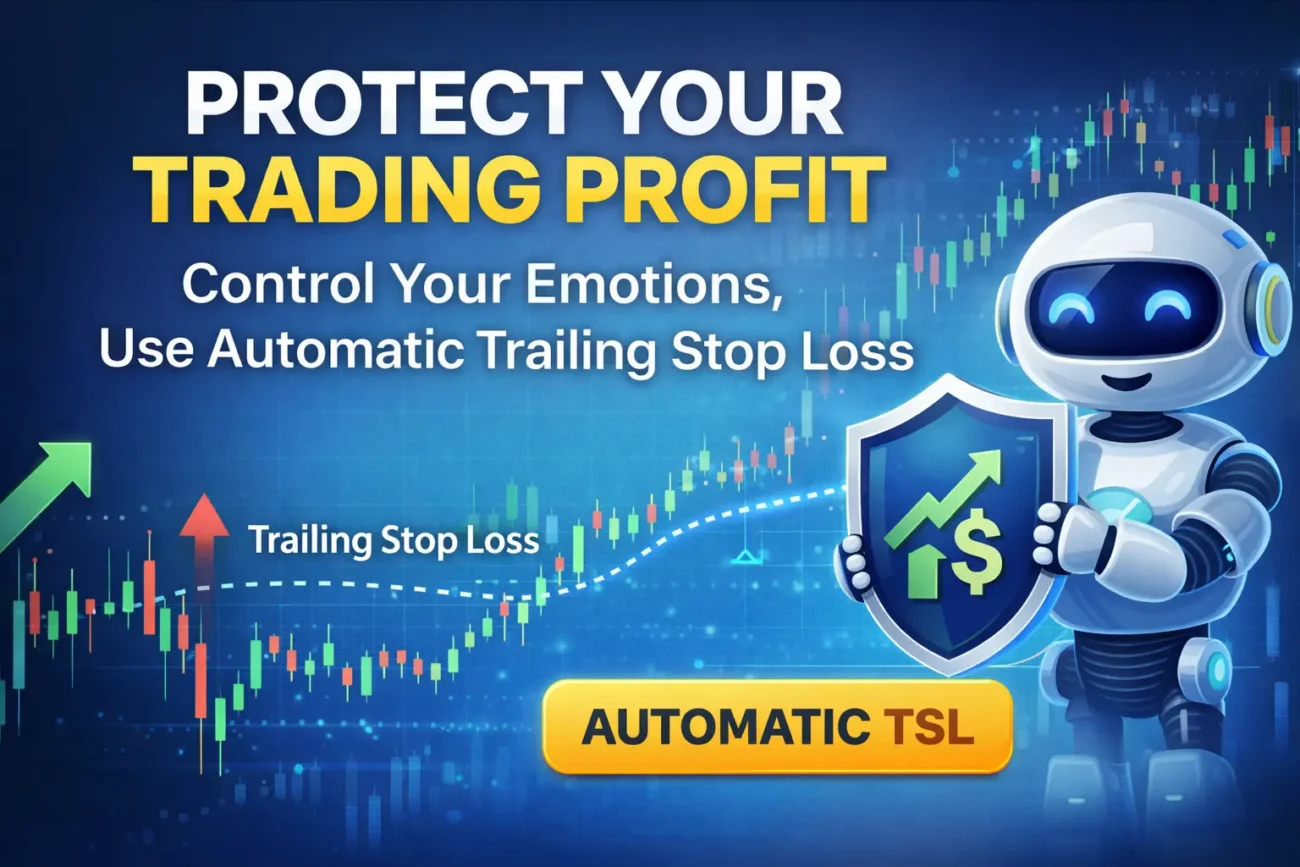
The Smart Solution: Automatic Trailing Stop Loss (TSL)

An automatic Trailing Stop Loss removes emotions completely.

Instead of asking:

“Should I move my SL now?”

The system does it for you, based on predefined rules.

Benefits of Automatic TSL:

  • Protects profit step by step
  • Locks gains logically
  • Adapts to market movement
  • Eliminates emotional decisions
  • Keeps consistency over time

How ZNJEA Robot Protects Your Profit Automatically

The ZNJEA trading robot is designed with one core objective:

Protect profits first. Grow accounts second.

Key Features:

  • Smart automatic Trailing Stop Loss
  • Logical SL movement based on price behavior
  • No emotional interference
  • Designed for long-term account survival
  • Suitable for prop firms and personal accounts

Instead of hoping the market continues,
ZNJEA secures profit as the market moves.


Final Thought

Protecting profit won’t make you rich overnight.

But it is the only reason your trading account survives long enough to grow.

Trading is not about maximizing one trade.
It’s about optimizing the entire journey.

If you master profit protection,
the market will finally start paying you consistently.


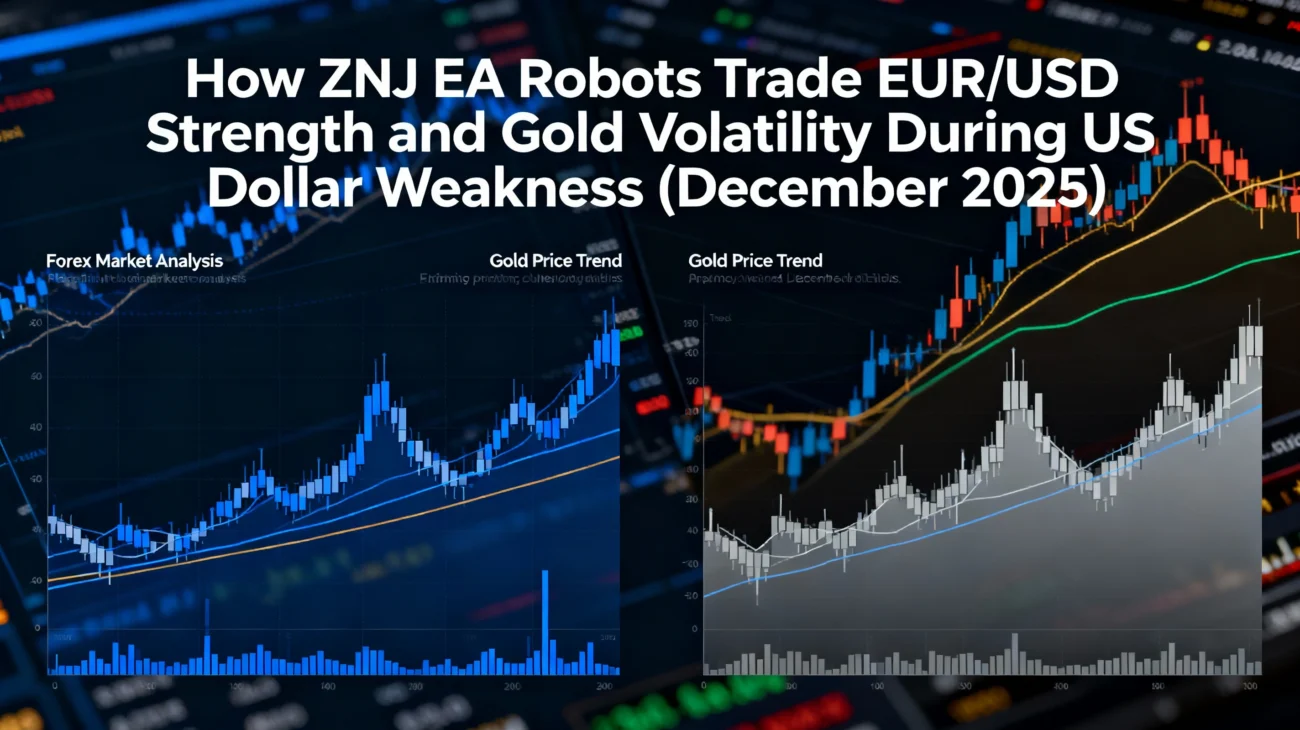
Feature image showing the title ‘How ZNJ EA Robots Trade EUR/USD Strength and Gold Volatility During US Dollar Weakness (December 2025)’ over forex and gold price charts on a trading screen.

How ZNJ EA Robots Trade EUR/USD Strength and Gold Volatility in December 2025

EUR/USD is trading above 1.16 while gold holds close to the 4,000–4,200 zone, as traders expect more Fed easing and continued US Dollar weakness into 2026. This macro backdrop creates strong trends and sharp intraday swings that are ideal for disciplined, rule‑based robots like your ZNJ EA to exploit.


Dollar Weakness and the December 2025 Macro Picture

The Dollar has been under pressure as markets price in further Federal Reserve rate cuts and a looser policy path into early 2026, reducing the yield advantage of USD assets. Several institutional outlooks now see a softer Dollar through mid‑2026 as rate gaps narrow and investors diversify into non‑USD currencies and gold.

This shift is happening while US data sends mixed signals, with softer growth and inflation keeping rate‑cut expectations alive even as some policymakers sound cautious. For forex traders, that combination tends to favor trending moves in Dollar pairs like EUR/USD and supports demand for alternative stores of value such as gold.


EUR/USD Above 1.16 – What the Chart Is Saying

EUR/USD has pushed above the 1.16 area, with recent price action staying in the upper part of its late‑2025 range as traders bet on at least one more Fed cut. Short‑term forecasts describe a market grinding higher, with resistance zones roughly around 1.17–1.1720 and support in the 1.14–1.15 region.

This means price is not in “cheap” territory, but momentum remains constructive as long as the pair holds above key support and US data does not surprise aggressively to the upside. For strategy design, EUR/USD in this phase tends to reward pullback buying within an uptrend more than random range trading against the broader move.


Gold Near $4,000–$4,200 – Volatility and Opportunity on XAU/USD

Gold is hovering around the psychologically important 4,000 level, with many analysts focusing on 3,900 as key support and 4,200–4,400 as the main resistance zone in December 2025. Short‑term technical views suggest sideways‑to‑bullish behavior, with corrections toward 4,200 and potential rebounds if buyers step in again.

Some research desks even discuss extreme upside scenarios where gold could move far beyond current prices in a multi‑year horizon if monetary policy stays loose and geopolitical risks flare. Even if those “black swan” targets do not materialize, the current wide ranges and frequent tests of support‑resistance levels provide rich intraday swings for systematic strategies.


Why This Environment Is Perfect for Trading Robots

Robots tend to excel when markets produce repeated patterns, such as trends with regular pullbacks or clearly defined ranges, rather than completely random noise. The current Dollar‑weakness phase delivers both trending EUR/USD behavior and broad gold ranges, which together create numerous, rule‑repeatable setups.

Human traders often hesitate, over‑trade, or panic during sharp intraday reversals, especially around Fed headlines and US data releases. Algorithmic strategies, by contrast, can execute pre‑defined rules consistently, monitor multiple instruments like EUR/USD and XAU/USD at once, and avoid emotional decisions when volatility spikes.


How ZNJ EA Logic Fits EUR/USD and XAU/USD Now

Your ZNJ EA concept is built around combining a higher‑timeframe trend filter (such as H1) with a lower‑timeframe execution chart (like M5), allowing it to trade in both directions while respecting the dominant trend. It also prioritizes risk management by using a risk‑per‑trade percentage, optional manual lot sizing, and a trailing stop that follows price to lock in profits.

In an environment where EUR/USD is biased higher but still experiences deep pullbacks around data, this structure helps the EA stay aligned with the bigger direction while entering on intraday dips. On gold, where price oscillates between major support and resistance zones near 3,900 and 4,200–4,400, the trailing stop and risk percentage help the robot survive fast spikes and reversals.


Example: ZNJ EA on EUR/USD in December 2025

Imagine EUR/USD trading above 1.16, with H1 candles mostly trending upward and price repeatedly pulling back toward a moving average or recent breakout zone. The ZNJ EA can use the H1 trend to confirm a bullish bias while relying on M5 patterns—such as local support bounces or momentum signals—to open long positions during dips instead of chasing tops.

When US data like CPI, ADP employment, or Fed communications hit the tape, intraday volatility often widens spreads and creates spikes both ways. In these moments, the trailing stop logic becomes essential: once a position is in profit, the stop moves up behind price so that even if the pair suddenly snaps back, the trade typically closes with a smaller give‑back instead of a full loss.


Example: ZNJ EA on Gold (XAU/USD)

For XAU/USD, current forecasts highlight how gold can swing between support just under 4,000 and resistance in the low‑4,000s, with traders watching 4,200 closely. In this environment, your EA can look for long entries near support in a broader bullish structure or short‑term mean‑reversion trades when price spikes into resistance and momentum fades.

Because gold moves much faster than most currency pairs, risk‑per‑trade settings matter even more; a small percentage risked on each position combined with the trailing stop allows the EA to participate in big trends without exposing the account to catastrophic losses. This is especially important around major US releases or sudden headlines, when spreads can widen and candles can jump hundreds of points in minutes.


Risk Management and Drawdown Control

Even in a “favorable” environment for robots, the biggest danger is over‑leveraging when trends look obvious, only to face a sharp reversal or a sudden consolidation phase. Good practice is to cap risk per trade, limit maximum simultaneous trades, and define a daily or weekly loss limit so that one volatile session does not damage the entire account.

Your ZNJ EA framework, with percentage‑based position sizing and trailing stops, naturally supports this approach, but users still need to choose conservative settings that match their account size and broker conditions. Adding filters such as time‑of‑day restrictions or news‑avoidance windows can further reduce exposure during the most chaotic moments if desired.


How Traders Can Use ZNJ EA Now

The safest way for new users to approach this environment is to start with a demo account, applying ZNJ EA to EUR/USD and XAU/USD to see how it behaves across different volatility regimes. Demo testing helps fine‑tune parameters like risk percentage, trailing‑stop distance, and allowed trading sessions before any real money is at stake.

Once the EA shows consistent behavior on demo, traders can move to a live account with small risk per trade, gradually scaling up only after gaining confidence in both the robot and their own discipline. For those who prefer a more hands‑off approach, copy‑trading setups running your ZNJ EA can provide exposure to this Dollar‑weakness theme without managing every technical detail themselves.


Conclusion: Turning Macro Themes into Automated Strategies

December 2025 brings together a rare mix of EUR/USD strength above 1.16, gold holding near major highs, and a structurally weaker US Dollar driven by expectations of ongoing Fed easing. By combining this macro picture with ZNJ EA’s trend filters, risk‑percentage sizing, and trailing stops, traders can systematically capture opportunities in both EUR/USD and XAU/USD while keeping risk under control.

Forex market update today 2025 with dollar steady, rupee gains and yen under pressure.

Flash Crashes & Systemic Risk in Forex 2025: How AI Trading Bots Shape Market Stability

Introduction

The forex flash crash 2025 risk is rising as markets become more automated and AI-driven.


1. The Evolution of Forex Into an Automated Market

Automation dominates the forex ecosystem.
Therefore, more than 80% of global currency trades are now executed by algorithms and trading robots. This shift has introduced several advantages, including tighter spreads and faster execution.
However, it has also created a market environment where errors can spread quickly.

Forex automation is driven by:

  • High-frequency trading (HFT) systems
  • AI prediction models
  • EAs on MT4/MT5
  • Automated liquidity engines
  • Smart order routing

Because so many systems operate simultaneously, even small disruptions can escalate rapidly.


2. What Is a Flash Crash?

A flash crash is a sudden and sharp drop in price that occurs within seconds. It is usually followed by a fast recovery.
In other words, the market collapses temporarily before returning to normal levels.

Typical flash crash features include:

  • Rapid price collapse
  • Liquidity disappearance
  • Massive spread widening
  • Execution delays
  • Stop-loss cascades

These events are dangerous because traders have almost no time to react manually.


3. Why Flash Crashes Happen in Forex

3.1 Liquidity Withdrawal

During periods of uncertainty, liquidity providers may pull their orders instantly.
As a result, the market becomes unstable and more vulnerable to sharp movements.


3.2 Algorithmic Overreaction

Algorithms are built to react quickly to price changes.
Consequently, when one algorithm triggers a sell order, others may follow, creating a chain reaction.


3.3 Stop-Loss Cascades

Flash crashes often trigger thousands of stop-losses.
Therefore, the downward movement becomes amplified, especially during high volatility.


3.4 High-Frequency Trading Withdrawal

HFT systems dominate short-term liquidity.
When they detect unusual volatility, they immediately withdraw, causing spreads to spike dramatically.


3.5 Data Glitches

Sometimes, markets react to incorrect information or delayed feeds.
For example, a wrong economic number or duplicated price tick can trigger algorithmic panic.


3.6 AI Model Synchronization

AI models increasingly learn similar patterns.
Consequently, thousands of bots may buy or sell at the same time, causing coordinated volatility.


4. The Bigger Issue: Systemic Risk in Forex

Flash crashes are symptoms of deeper systemic issues.

4.1 Highly Connected Markets

Forex pairs influence each other.
Therefore, when a major pair like USD/JPY crashes, gold, crypto, and stock indices often react instantly.


4.2 Central Bank Concerns

Regulators are worried because:

  • AI evolves faster than regulation
  • Machine behavior is unpredictable
  • Market manipulation becomes harder to detect

Furthermore, even central banks now use AI tools to monitor global liquidity.


4.3 Retail Trader Exposure

Retail traders rely heavily on automation:

  • EAs
  • Copy trading
  • VPS setups

However, without proper filters, these tools can amplify risks during a flash crash.


4.4 Prop Firm Sensitivity

Prop firm accounts have strict daily limits.
Therefore, even a small flash crash can instantly violate rules.


5. How EAs Influence Flash Crashes

5.1 How EAs Make Crashes Worse

Certain robots increase market instability because:

  • They are over-optimized
  • They use martingale or grid strategies
  • They have no stop-loss logic
  • They do not include volatility filters

Consequently, these robots are often the first to blow accounts during chaotic events.


5.2 How EAs Help Prevent Losses

Modern EAs include:

  • Spread filters
  • ATR volatility control
  • News filters
  • Equity protection
  • Auto-shutdown during spikes

Moreover, advanced AI EAs can detect abnormal market behavior before humans notice.


6. Why Flash Crashes Are Increasing in 2025

6.1 Growing AI Adoption

As more traders use AI bots, the probability of synchronized behavior increases.

6.2 Retail Automation Growth

More retail EAs means more identical strategies.
Therefore, market reactions become amplified.

6.3 Volatile Global Conditions

Political instability and interest rate uncertainty are pushing markets into higher volatility.

6.4 Rise of Digital Currencies

New CBDC systems introduce additional liquidity risks.
As a result, the forex market becomes more complex.


7. How Traders Can Protect Themselves in 2025

7.1 Use Well-Designed EAs

Avoid robots that:

  • Use martingale
  • Trade without stop-loss
  • Do not manage volatility

Instead, look for EAs with:

  • Drawdown protection
  • Volatility filters
  • Smart SL/TP placement

7.2 Avoid Trading Major News

High-impact events such as NFP and FOMC often trigger flash crashes.
Consequently, staying out of the market during these moments reduces risk.


7.3 Use ECN Brokers

Brokers with deep liquidity reduce slippage.
Therefore, they perform better during sudden market drops.


7.4 Use a Low-Latency VPS

Execution speed matters during volatility.
In addition, VPS hosting prevents delays that could worsen losses.


7.5 Combine EAs With Manual Knowledge

Automation helps, but manual analysis improves risk management.
Moreover, traders who understand price action react better to unexpected events.


8. Are Forex Flash Crashes Becoming More Common in 2025?

Yes — they are.
However, better AI tools are also emerging to protect traders.

The future will rely on:

  • Human experience
  • Smart automation
  • Strong risk management

Therefore, the best traders in 2025 will combine technology with disciplined strategy.


Conclusion

In 2025, the forex flash crash 2025 risk is real, but traders can reduce it with smart automation and risk management.

The Rise of Robo-Advisors: AI in Stock Trading Decisions

Introduction

In recent years, the financial world has witnessed a digital revolution. Robo-advisors, powered by artificial intelligence (AI), are changing the way traders and investors make stock trading decisions. Unlike traditional financial advisors, these AI-driven platforms can analyze vast amounts of market data in seconds, offering personalized investment strategies with minimal human intervention.

What Are Robo-Advisors?

Robo-advisors are online platforms that use algorithms and AI to manage investments automatically. They provide financial advice based on your risk tolerance, investment goals, and market trends. These platforms have become increasingly popular among both beginner and experienced traders because of their efficiency, low cost, and data-driven insights.

How AI Improves Trading Decisions

  1. Data Analysis at Scale – AI can process millions of data points from global stock markets in real-time, identifying trends and patterns that human analysts might miss.
  2. Risk Management – Robo-advisors assess risk continuously, adjusting portfolios to minimize losses during volatile market conditions.
  3. Personalization – By learning from a user’s trading behavior, AI can provide customized strategies tailored to individual goals.
  4. Emotion-Free Decisions – One of the biggest advantages is eliminating human biases like fear and greed, which often lead to poor trading choices.

Benefits of Using Robo-Advisors

  • Lower Costs: AI platforms reduce the need for expensive human advisors.
  • Accessibility: Anyone with an internet connection can access these tools.
  • Efficiency: Automated trading strategies save time and effort for investors.
  • Consistent Performance: Algorithms follow strict rules, leading to more disciplined investment approaches.

Challenges and Considerations

While AI in stock trading offers many benefits, it is not without risks:

  • Market Volatility: Robo-advisors rely on historical data and algorithms, which may fail during extreme market conditions.
  • Lack of Human Judgment: Complex market situations sometimes require human intuition.
  • Security Concerns: Since all trading is digital, cybersecurity is a top priority.

The Future of Robo-Advisors

The adoption of AI in trading is expected to grow significantly. Future robo-advisors may integrate machine learning models that predict market movements with higher accuracy, offer real-time portfolio optimization, and provide more interactive user experiences.

Conclusion

Robo-advisors are revolutionizing stock trading, making it more efficient, accessible, and data-driven. While they are not a perfect replacement for human advisors, they are a valuable tool for investors looking to maximize returns while minimizing effort and emotional trading mistakes.

Product has been added to your cart